Archive for the ‘General Respiratory’ Category
 June 2nd, 2010 |
  Author:
 The revision lectures for the 2nd years have started in earnest. Dr Short delivered a wide ranging session on CAP, Bronchiectasis, TB, CF, Abscessed and much more. If you want to go through the lecture again, here it is:
Revision Lecture 1
And I know how much you all like to have your lectures posted up before the lectures actually happen, so here’s my lecture for next week:
Revision Lecture 2
See you all next week!
Teaching the 5th years in the final gasp of their medical school career, the APART course last week ran them through some scenarios of acutely unwell patients. This was quite literally their last two hours of medical school before starting work in August and I was surprised at the sea of blank faces when they were faced with a COPD patient in type two respiratory failure. The progressive (simulated) decline of the patient (accompanied by my now legendary impressions of “elderly confused woman” and “obstructed airway”) did little to trigger the request for non invasive ventilation. Comments like “ask ITU to keep an eye on them” did little to quell the rising panic in my little respiratory educationalist heart. Once the topic of NIV was broached there remained an air of mild confusion and the whiff of misunderstood acronyms in the air. What is BiPAP, CPAP, NIPPV? Can’t you just tube them all? I find myself relieved that the new and improved respiratory teaching for the second years will go some way to exposing our students to this most oft used and useful of therapies, but what of the students in the more senior years? DundeeChest 3.0 to the rescue….? When I find some useful web resources in this area I will post them, but I have to admit I’ve come up short so far.
 Posted in General Respiratory, Medical Education |
  Tags: Acute Medicine, COPD, NIV, Revision |
  1 Comment »

Carlsberg don't do anaesthetists....
That headline has nowt to do with this post but I feel an obligation to myself, and to all those who hold the pure art of the pun in high regard, to use it. Mind you, there is plenty of scope for pun-age with the article from Chest that caught my eye – “Fighting Vampires and Ventilator-Associated pneumonia: Is Silver the magic bullet?“. Aside from briefly thinking that Buffy had widened her slayer repertoir to include pathogenic bacteria (a much more sedate spin off series methinks), this piece is an editorial on the publication of the NASCENT study in the same edition. It looks at the antibacterial effect of silver coated endotracheal tubes on the mortality rate of ventilator associated pneumonia in ICU. The study authors are fairly upbeat in their message suggesting that it “was associated with reduced mortality in patients who developed VAP in the NASCENT study”. The editorial is less convinced, and gives a good overview of the state of play for this difficult condition, ending with the upbeat message that rates are already in decline with the introduction of good old fashioned hygiene in the form of ventilator bundles, so you may not need your fancy pimped up ET tubes anyway. So there.
Confused 2nd year student, Anna, says:
Hi – I’m struggling to comprehend the management of acute asthma. I was just looking in a textbook and at the BTS Guidelines management of acute asthma – but I’m still a little confused.
What do you give and in what order and how much?
I know you give O2 to maintain sats at 94-98% and nebulised Salbutamol – but how much? What is the dose for Ipratropium? – Inregards to steroids again BTS simply mentions “Give steroids in adequate doses in all cases of acute asthma. Continue Pred. 40-50mg daily for at least 5/7 or until recovery” – what is the starting dose? and what is the clinical indication/point at which IV magnesium is considered?
Is there a Tayside Protocol? I’m sure there must be one, but I can’t find it.
Thanks – I’m probably confused over something really simple, but I’d really appreciate the clarification as I don’t want to mistreat a patient one day!
In order:
Oxygen – yes, you have it right.
Salbutamol – 5 mg, nebulised, driven by oxygen, not air
Ipratropium- 500 mcg nebulised, driven by oxygen, not air
Steroids – 50 mg prednisolone PO, or 200 mg hydrocortisone IV. Locally we give 25 mg prednisolone BD for the acute phase, and swap to 50 mg OD for discharge. We usually give 5 to 7 days, or until they get better.
IV Magnesium – it’s on the protocol, and we do use it. 1.2 – 2 g MgSO4 given IV over about 20 minutes. We say to give it if there are any life threatening features. The evidence for it is mixed, but anecdotal evidence is striking. Don’t let IV magnesium administration delay calling the anaesthetists when the patient begins to develop type 2 respiratory failure.
The Tayside protocol is stuck on the wall in ward 15, it’s in the protocol book in ward 15, and it’s on the intra-net somewhere. I’ll try to dig out an electronic version and post it up here.
Laura, stalwart member of PRN, and long time DundeeChest user, has asked about how to make the diagnosis of asthma.
There’s a guideline for that! And in it is has a nice diagram suggesting the signs and symptoms that suggest a diagnosis of asthma, and those which do not suggest a diagnosis of asthma.
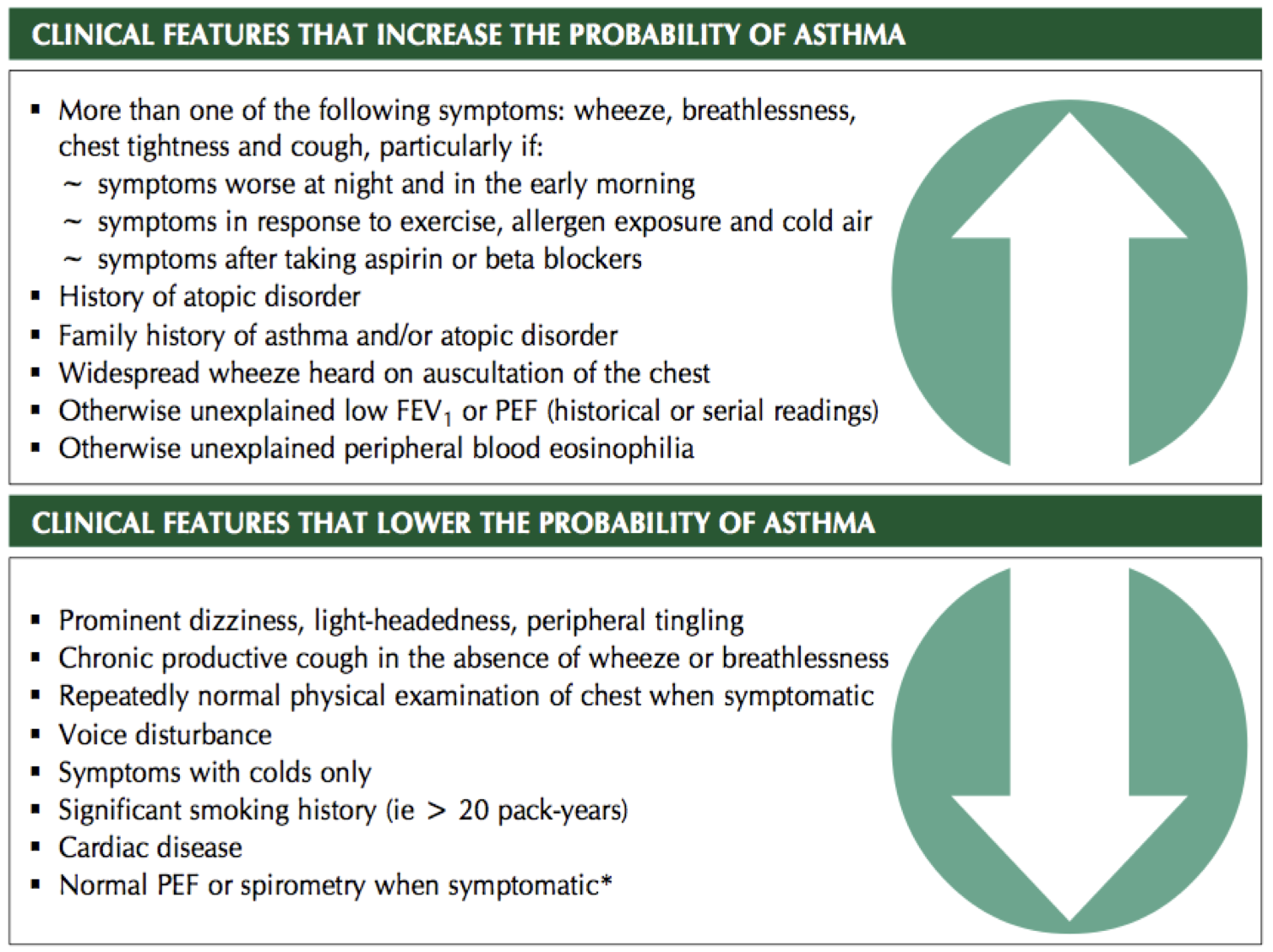
Is asthma a likely diagnosis?
When you’ve weighed up the pro and con probabilities, you can determine whether asthma is of high, low, or intermediate probability. If it is highly probable, give a trial of treatment and assess response. If it is of low probability, seek alternative diagnosis. If it is of intermediate probability, spirometry might be helpful, or might not, and a PEF diary might be useful too. A trial of treatment, and early review is usually the most useful test.
Start pharmacological management appropriate to the severity of symptoms, but aim for control of asthma, regardless of severity.
The respiratory sounds lecture I put up on the old DC site has mysteriously vanished!
So, after some shenanigans with FTP uploads, it’s here instead.
Someone has asked me to put up the respiratory revision lecture! I think it was more of a chat than a lecture I can actually put up. I can put up a summary of what we talked about, if you like?
Inhaler technique is clearly important – we can give the patient any drug we please, but it they can’t use the inhaler device properly, they might as well be sticking it up their….
So it begs the question, how good is *our* inhaler technique? Are we the blind, leading the blind? In the kingdom of the blind, the one eyed man is king, lest we forget.
In the Asthma and Allergy Research Group (AARG) the Asthma and Allergy Research Fellows (AARFs) are embarking on a research project to test the inhaler technique of various grades of various health care professionals. They were down at the educational meeting last Friday to test out the consultants (Professor Lipworth assures us that the machine he was using was “Broken, obviously”), and now they want to roll it out to a wider audience. The idea is to do a baseline screen of technique, intervene, and then close the loop. There’s bound to be a poster in it, probably a short paper for a journal. Anyone out there interested in taking part in the research, getting their name on a poster, or even writing a paper?
Posted in General Respiratory, Research Opportunities |
Tags: AARF, AARG, Inhaler Technique, Video |
No Comments »
I have been asked to deliver a revision course to the 2nd years on the whole of respiratory medicine. I have an hour, maybe an hour and a half, following my team roles session at 12:30 on Wednesday. The team roles session should be over by 1:30, and we can decant to a lecture theatre then, and do some learning.
Post your questions in reply to this post, so I can prepare the session – you ask, I answer. Hopefully.
So, tirez.
EDIT: The lecture will now be in LT2, starting at 1pm, as the interest in the team roles session has been, erm, 1 person, so I’ve cancelled it.
Inquisitive user El on the AskDundeeChest page has asked another question!
Would you be able to explain the difference between types 1 and 2 respiratory failure and the pink puffers and blue bloaters?Books are very unclear about this!
Here’s my response, as it might be of use to more students out there:
OK. This is the question I get asked about the most, the concept people get wrong most often, and is consistently poorly understood.
Type 1 respiratory failure is hypoxaemia. The pO2 is low, the pCO2 may be low (due to hyper-ventilation to compensate for hypoxaemia) or normal.
Acute type 2 respiratory failure is hypoxaemia with hypercarbia. The pO2 is low, the pCO2 is high. pH is usually low. This follows type 1 failure, usually because of exhaustion, and consequent hypoventilation.
Chronic type 2 respiratory failure is hypoxaemia, long standing hypercarbia with metabolic compensation. The pO2 is low, the pCO2 is high, the HCO3 is high. pH is normal. This can occur in any disease that causes chronic hypoventilation.
Acute on chronic type 2 respiratory failure is hypoxaemia, long standing hypercarbia with metabolic compensation, and an acute event leading to a further hypercarbia, and consequently, acidaemia. The pO2 is low, the pCO2 is very high, HCO3 is high, the pH is low. Think acute exacerbation of any cause of chronic type 2 respiratory failure.
Forget blue bloaters and pink puffers, the concept is not useful, to my mind.
I hope that helps you all out there!
Posted in General Respiratory |
Tags: Acidosis, Acute, Chronic, Hypercarbia, Hypoxaemia, Respiratory Failure, Type 1, Type 2 |
No Comments »
User El has asked a question over on the AskDundeeChest page of the site
DC : in asthma, can you explain the order of drugs used, I don’t really understand the circumstances for using ACh antagonists, is it just in acute asthma these are given?thanks
As ever, the information is easily at hand on the BTS website, under the asthma guidelines section. But here’s the relevant page for you (Click it to make it bigger):
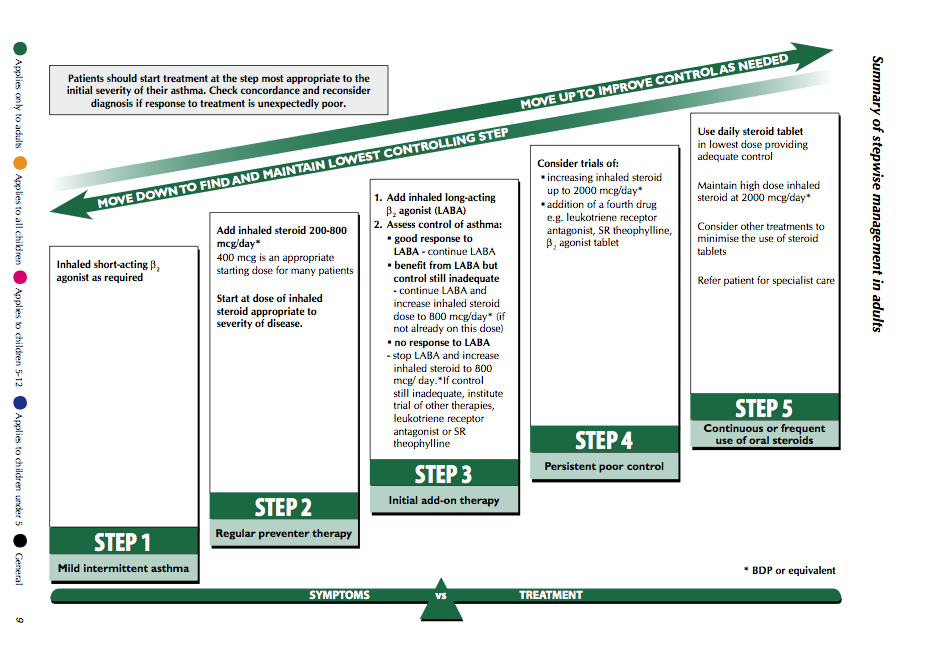
From the BTS Asthma Guideline 2008 Updated 2009
In answer to the last part of the question – Anti Cholinergics have no evidence base in asthma, despite there being a valid theoretical place for them in a bronchoconstrictive syndrome.


