Archive for the ‘Editorial’ Category
 February 19th, 2013 |
  Author:
  We are proud to announce that we have been successful in our application for funding from Tenovus-Scotland to start our first clinical trial of 2013. Richard Stretton, James Chalmers, and Tom Fardon will be leading on the study, looking into the effects of pulmonary rehabilitation in bronchiectatic patients.
After a short delay, we have now received the feedback from the phase 2 students for the respiratory block. 69 of the second year responded, which is a little disappointing, but the comments have proved to be very valuable, both negative and positive.
A more comprehensive response will follow, but for now, the main issues raised by the students are.
1. The order of the lectures is not always helpful.
2. The ward based teaching is too variable, with some students getting a lot out of it, and some not.
3. The students like the study guide (which I had thought you all wouldn’t, TBH), and want paper copies of it earlier.
We will be focussing on these issues primarily for next year, so thank you for the feedback. I was particularly encouraged that there were no complaints about lack of formative assessment in the block, in stark contrast to last year!!!
Positives were numerous, but the top 3
1. The ABG tutorial went down a storm, and Dr Stretton’s delivery particularly. In my defence, I did *write* the tutorial…. 😉
2. The MDT was well liked, but I totally accept that the roles should be rotated for each case
3. Changing private study into small group sessions was universally liked, with no-one asking for more private teaching time.
DundeeChest was well liked, and most of you preferred it to BB, apart from one person who prefers the BB discussion forums.
The MDT sessions seem to be going well enough. There’s been subtle iterations through the week, and tomorrow I might even manage to fit everything in. A couple of you have given some positive feedback about the MDT sessions – I think they have gone well. Most of the decisions have been in line with what happened in real life, which must be a good thing.
I have been disappointed that so few people have read through the information I have provided on “What to tell patients with Lung Cancer” as provided by the BTS. This useful document gives data on what kind of life expectancy lung cancer patients can expect, with and without treatment. We don’t have this data locally, so I can’t really tell you what goes on in Tayside.
On a more positive note, the staff on the ward and in East Block have commented to me that the second years who have come down to the department, been on ward rounds, come to clinics, visited the MDT, have been keen, enthusiastic, and interested. This is a very positive reflection on those of you who have come down, so well done. Someone even came to the real MDT today, to see how it really happens.
Dr Lockhart has given me his 2010 update to his microbiology lecture, so this is now on the microbiology resource page. All the materials from last week’s ITA are now up on the Basic Sciences ITA page too. This week’s MDT materials will go up on line when I get the digital copies from Richard.
Next week I have timetabled a lecture on Respiratory Illness and Oxygen Therapy. This lecture is one I usually leave blank, to give you the choice of what I talk about – last year the choice was Respiratory Illness and Oxygen Therapy. So I’m open to suggestions – what would you like me to talk about on Thursday of next week? I will use some of the time to talk about the RoCE exam, I would quite like to talk about oxygen therapy at some point, but I’m in your hands.
 Posted in Editorial, General Respiratory, Phase 2 |
  Tags: lecture notes, MDT, Phase 2 2010, week 3 |
  No Comments »
The MDT sessions are going well, I think. Monday’s session was a little disjointed, as it was the first ever session, leading to the oncologists having little to do until the MDT itself. To fix this, I wrote some cases for the oncologists to go through in the first 45 minutes, and they seemed to get more out of the session because of it.
Much of the discussion revolves around prognosis, and the benefits of giving chemotherapy to patients, in terms of prolongation of life, and quality of life. Disappointingly no-one had read the information I provided on “What to tell a patient with lung cancer”, which answers much of these questions. The Lung Cancer Resource Page also has on it other interactive resources about lung cancer staging, lung cancer cases, patient journeys etc.
For tomorrow’s session:
1. I will be 5 to 10 minutes late as I have to speak to the 3rd years before coming to the session. So have an extra 5 minutes in bed.
2. I am in the process of updating the materials, particularly for the chest physician group. The new materials can be made available to everyone at the end of the week.
Just a quick note to commend DundeePRN to you all. I helped set up the site last year with a group of second years. The site is going very well – the 3rd years are now up and running with their materials this year, and things are going from strength to strength. There’s 3 podcasts this year, already!
What the site really needs is some 2nd years (and 1st, 4th and 5th years) to get involved in writing content, posting comments, and making things happen. Head over to the site, register, and start contributing.
If you want some assistance with recording podcasts, writing content, etc, just let me know.
 Welcome to week 2. Now we get into the fun stuff, putting to good use all that physiology and getting to practise your new found clinical skills to appreciate the clinical presentation of patients with obstructive lung diseases. We will have you pitting your lung function against each other with our spirometry machines, we will show you how to help manage patients with and without the use of medications and give you your own personal Rosetta stone to interpret Arterial Blood Gases. The week 2 study guide is now available here. Of course, all of the lecture material and formative assessment for this week is available on the blog. Now don’t say we’re not good to you…..
Posted in Editorial, Phase 2, Study Guide |
Tags: Formative Assessment, Lectures, Study Guide |
No Comments »
 So, we’ve made it through week 1 in one piece. Yes there have been a few slip ups, a missed lecture and delayed ward teaching as well as a few technical hiccups, but on the whole I think we got through unscathed. All these issues have now been addressed or rectified – and thanks for letting us know about them early. Remember, if you want to go over the lecture material from this week it is all here on the site as well as some formative assessment to make sure you are up to speed. And don’t forget about the iCAST material – may be a long and winding road to get to it, but I think it is well worth it. Let us know in the comments what you think of week one or if there are any issues you haven’t told us about yet. And if you haven’t already made use of “Ask DundeeChest” – feel free. There have been some good questions and answers posted there already. I mean, where else do you have a students question answered by both the Professorial System Convener as well as the Phase Convener within 24 hours? Where else? Nowhere else, that’s where.
So, sorry about the pharmacology lecture. Dr Wilson assures us that he will fit everything in tomorrow, and I’m sure he’ll be available to answer questions in both real life, and on the blog.
The questions are starting to come into “Ask DundeeChest”. I can answer some of them, but as I’m not a respiratory physiologist, I will ask Dr Khogali to answer the more technical of questions, particularly as he wrote the lectures!
Dr Goudie has kindly pointed out that there are a couple of mistakes in the Week 1 “ITA” session material. A case of an arrow the wrong way around, two figures swapped around, and a typo. The material is created quite quickly, and despite proof reading, these mistakes do occasionally slip through. I can’t edit the changes from home, so I’ll try to sort it tomorrow, and get the corrected version up by Friday.
Many of you are asking for the study guide. Apparently you’ve been told that there isn’t one – this isn’t strictly true. There is one, but I am trying to make some changes to it to bring it up to date. I suspect I’m going to have to give you the week 1 part now, then the other weeks as we go along. I’d rather get you things that make sense, than last year’s materials, which are a little out of date.
I know that we are still waiting for a couple of the lectures to go online. We are aware, and we’re hunting down the culprits. They know who they are.
I hope you’re enjoying the course, and things are, apart from the above-noted, going smoothly. 1431 hits to the site today!
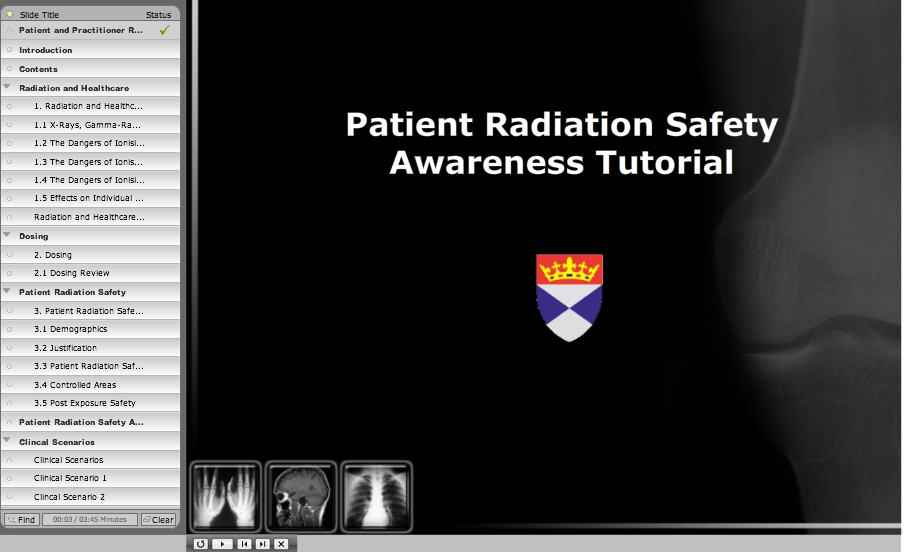 Over the Summer Vacation David Smith, one of the new 3rd year medical students, spent 6 weeks working on an interactive tool to improve awareness of ionising radiation doses associated with commonly requested radiological investigations.
The tool is now viewable here. This is a fantastic resource – I wholly recommend it to medical students, junior doctors and even consultants as a refresher!
Well done to David, on a fantastic piece of work.
Posted in Editorial, General Respiratory |
Tags: e-learning, interactive tools, Radiation, Tutorials |
5 Comments »
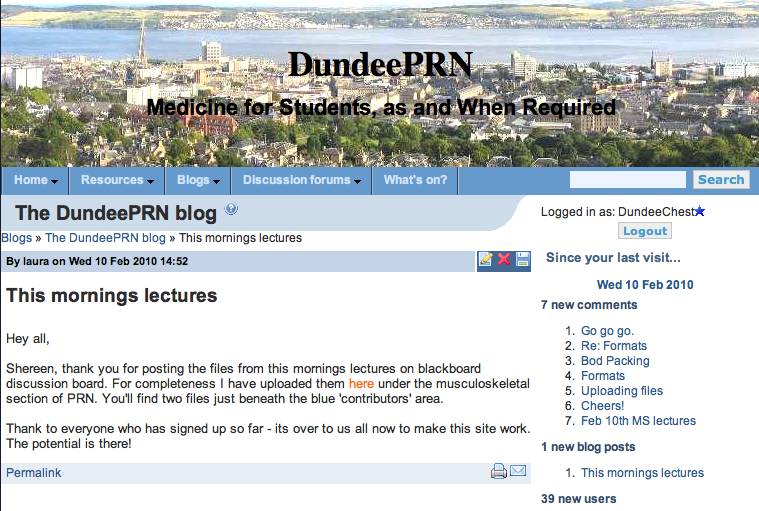
Launching Today!
It’s web 2.0, then? What happened to web 1.1.4, and web 1.3.8? What about web “Snow Cheetah”? Well, it’s web 2.0 until we get to web 4.0, I’m told. So about time we got with the program, and brought the Dundee Medical Course into the “teen-ies” (after the nought-ies….). The Dundee Blogging Network aims to do just that, and spearheading the attack is DundeePRN. I don’t know of any other medical school who is running the same thing: a student led; student written; student delivered; student edited, moderated and administrated web based resource of the same scope as DundeePRN.
A couple of the students have put in literally hundreds of hours over the past 4 months putting this together, and the fruits of their labours are starting to be evident now.
We launched the site during lectures today (DundeeChest braving the outside world despite his precarious post operative condition), and already we have over 60 users registered with the site. We start the analytics from today, to see how the site is utilised – we hope to get the other years involved in this as soon as possible.
The site is available to everyone and anyone – some pages are only visible to registered users, but there’s nothing stopping anyone registering.
Exciting times…
Posted in Editorial, Featured, Medical Education |
Tags: blogging, DundeePRN, launch |
No Comments »


