 February 12th, 2010 |
  Author:
 The Scottish Thoracic Society webpages have recently received a comprehensive overhaul. The new site should be easier to navigate, and give a more clear idea of what’s going on in the society.
The latest entry is the training program for the March 2010 session, on Lung Cancer in Stobhill.
Visit the STS site to learn more
 Posted in General Respiratory, Medical Education, Site Updates |
  Tags: Scottish Thoracic Society, STS, Training |
  No Comments »
Launching Today!
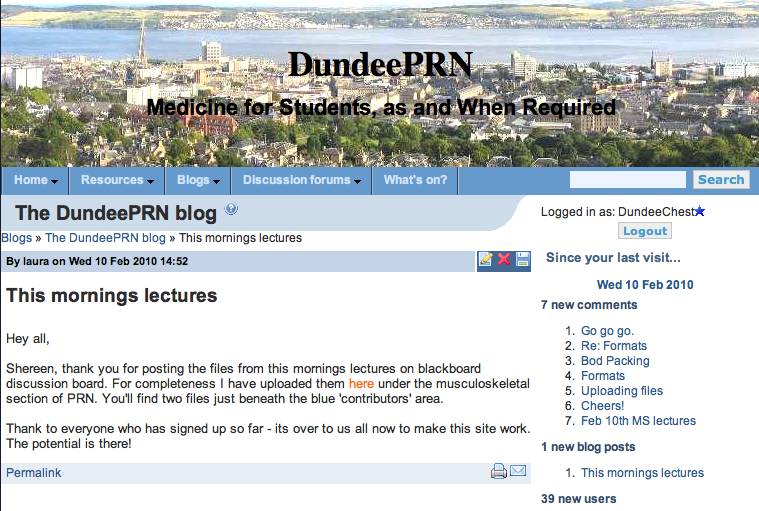
It’s web 2.0, then? What happened to web 1.1.4, and web 1.3.8? What about web “Snow Cheetah”? Well, it’s web 2.0 until we get to web 4.0, I’m told. So about time we got with the program, and brought the Dundee Medical Course into the “teen-ies” (after the nought-ies….). The Dundee Blogging Network aims to do just that, and spearheading the attack is DundeePRN. I don’t know of any other medical school who is running the same thing: a student led; student written; student delivered; student edited, moderated and administrated web based resource of the same scope as DundeePRN.
A couple of the students have put in literally hundreds of hours over the past 4 months putting this together, and the fruits of their labours are starting to be evident now.
We launched the site during lectures today (DundeeChest braving the outside world despite his precarious post operative condition), and already we have over 60 users registered with the site. We start the analytics from today, to see how the site is utilised – we hope to get the other years involved in this as soon as possible.
The site is available to everyone and anyone – some pages are only visible to registered users, but there’s nothing stopping anyone registering.
Exciting times…
Posted in Editorial, Featured, Medical Education |
Tags: blogging, DundeePRN, launch |
No Comments »
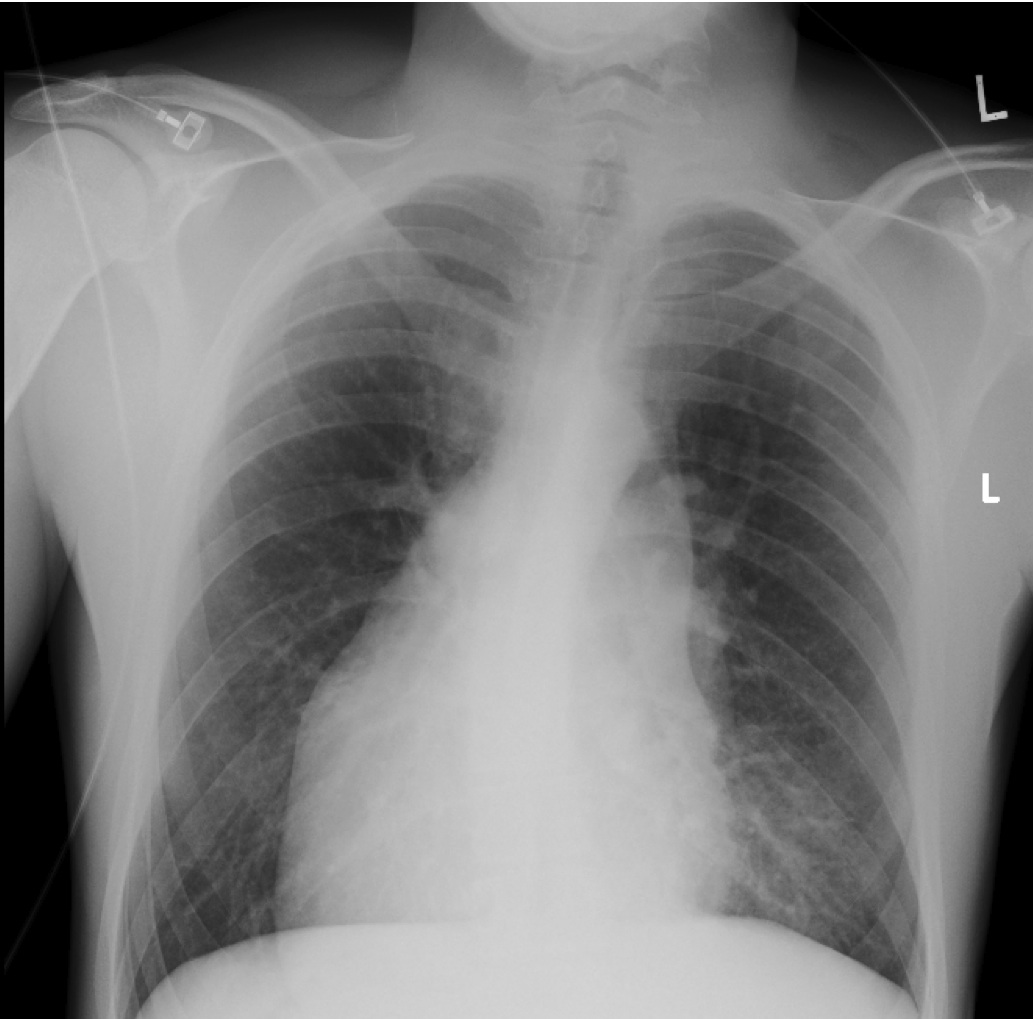
There's definitely something not right here
Posted in Featured, General Respiratory, Pulmonary Puzzle |
Tags: Case of the week, CXR |
No Comments »

Yes, that is a crystal studded MDI....
A recent paper in Chest has suggested that the staple treatment for COPD may not be the knees of the bees after all. Inhaled corticosteroids (ICS) have been the cornerstone of COPD management for some time, with the aim of reducing inflammation and (hopefully) cutting exacerbation rate. The TORCH study successfully did away with thoughts of ICS improving survival (ahh, the agony of p=0.052) but at least we have the principle of symptom control to cling to don’t we? Well, don’t we?
The clever bods from Chandigarh, India have taken 11 large prospective, double-blind, randomized, placebo-controlled trials and passed it through their Metaregression-ometer and come up with the conclusion that “The benefits of ICS in preventing COPD exacerbations seems to be overstated”. The collected statistics from the 8,164 patients pooled from seminal papers including ISOLDE, TRISTAN and TORCH showed that “we did observe a modest benefit of ICS in preventing COPD exacerbations in patients with FEV 1 < 50%. However, this finding was not further substantiated on a metaregression analysis wherein we did not observe a significant effect of baseline values of FEV 1 (percentage predicted) on the benefits from ICS compared with placebo. Thus, ICS is likely to have only modest benefits in preventing COPD exacerbations, if at all, and should be judiciously used in patients with COPD keeping in mind the risk-benefit ratio.”
I’ll admit my utter ignorance of the nuances of metaregression analysis and its potential flaws when used like this, but I would hope that the use of words such as “likely” and “modest” would hint that the analysis has scope to be challenged by people with more statistical savvy than my good self. Mind you, it doesn’t really matter does it, what with the veritable panacea of COPD drugs at our disposal…………(right, anyone got shares in Roflumilast?).
For Sale?
While the main headline grabber from the Tobacco and Primary Medical Services bill passed in Holyrood last week was the banning of the display of cigarettes, there was another hugely important aspect of the bill that passed with barely a ruffle in the feathers of the great media Chicken. In fact I couldn’t even find mention of it on the BBC website. They voted unanimously to keep private companies out of running General Practice services. “Why of course, that runs against the very fabric of the NHS” says you, but commercialisation of the Primary sector is very much alive and kicking south of the border. I would like to use superlatives to stress just how widespread it is but in fact it is difficult to know. What I can stress however is just how radically different the NHS is south of the border both in Primary and Secondary care, having just moved up from the Newcastle area.
For those in the dark, essentially the primary care trusts (PCTs) now hold all the cash and they essentially “buy” services for their patients (also called “Practice Based Commissioning” – my, how I love management speak). This means that they will pay the hospital respiratory outpatient department, say £40 for a new appointment, £20 for a review. For their cash they would expect a good service. If they don’t feel they are getting it, and there happens to be a nice bunch of specialists who have set up their own service and undercut the hospital by £10, then the Primary care trusts can dictate that all their chest patients go to “Stretton inc. Respirology”. The PCTs also know that follow-up of chronic disease can easily be done at the practice, saving them money, and so are reluctant for the old fashioned 6 monthly clinic review. The PCTs therefore hold the power and keep the money not spent as profit to invest in other services (or dare I say it – wages). This is where the private companies come in, if they see a profitable GP practice they can swoop in, buy up the practice and take over all the administration (the bit most GPs hate) while offering the doctors a guaranteed steady healthy wage. These companies are however duty bound to put the financial health of their shareholders at the top of their agenda. Some large American health insurance companies are starting to do this in England as the NHS is seen very much as the most lucrative untapped market in Europe. Is that the sound of doom I hear?
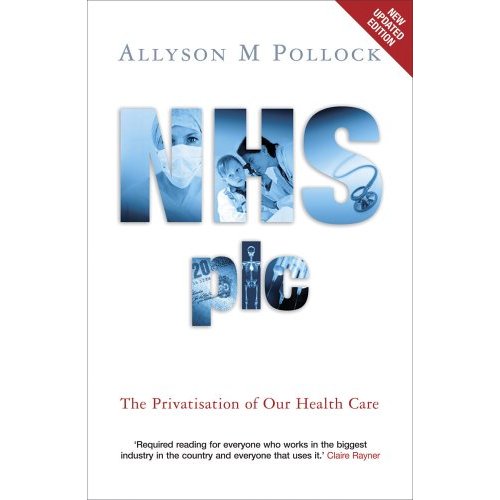
Services farmed out to private ventures (Polyclinics ring a bell?) means that the hospitals stop getting their cash and an outpatient service can be stopped altogether. This is already happening in certain areas of England. For an excellent treatise on this parlous state of affairs the book “NHS plc” is spot on.
So what does this mean for the respiratory outpatient clinic? Well, despite my revulsion at the financial driving force, I found that clinics had to up their game in the service they were providing. Less long term reviews meant more new patients which meant more money for the hospital and shorter waiting times. Clinics were set up to provide a vast array of services on the day. I could see a patient and have a 6 min walk, skin patch testing, ABG, ambulatory Oxygen assessment and inhaler technique all done before the patient went home. The financial pressures meant meticulous records of patient numbers, diseases and waiting times were recorded, and regularly reviewed, not only providing a valuable audit resource but could also prove how much money the department was bringing to the hospital, and therefore be used as a very effective method of leverage when pressing for investment into further services. The inpatient sector was no different, although there was no alternative service provider for the PCT they would expect a certain value for money depending on the reason for admission. A “menu” of diseases and the cost of admission meant that PCTs were billed for what they sent in. The onus however is on the hospital doctors to record the problems because it is actually clerical staff who flick through the notes and state ‘COPD’ or ‘Heart failure’. Given that the hospital would receive about £1000 more for COPD and Type II resp failure than COPD alone, then the problem list for the admission had to be meticulous (or certainly we were roundly thrashed if it wasn’t – it’s hard down south), which again provided another valuable audit trail.
The financial incentives to raise or maintain the standard of services is all pervasive in the English NHS. The fear in hospitals of losing services to a private venture, beholden to its shareholders, is actually creating some change for the better. Let me be completely clear that I abhor the infiltration of the NHS by the private sector but from what I witnessed market forces were moulding a more efficient service, it’s just a pity there has to be a market behind it.
Posted in Editorial, Featured, General Medicine |
Tags: Legislation, Privatisation, Rant, Respiratory |
No Comments »
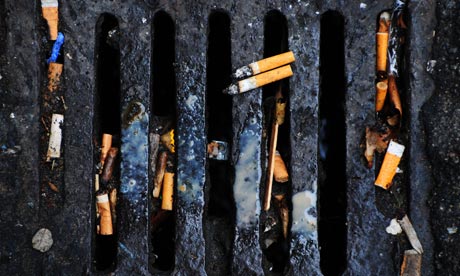
The drain outside chest clinic....
As ever the Scottish Parliament do their best to nose ahead of Westminster in their implementation of forward thinking policies. The recent vote at Holyrood in favour of banning cigarette displays is now closely followed by the Department of Health publication “A Smokefree Future” outlining strategies to control tobacco in England. Little nuggets like banning smoking in doorways would be welcome, although would probably be as effective as the mournful ghostly voices from the tannoys outside Ninewells telling a legion of deaf smokers to put out their fags. “Fresh air garden” indeed (how exactly do you grow fresh air??). The Guardian has a good piece on how far the proposals go eg. stopping short of banning smoking in cars, but also give voice to the pro-smoking campaign. There is little to comment about their position as I think most intelligent free thinkers can come to their own conclusions about their arguments. “Got to die of something” and “free will” are crackers and always makes me think we should encourage unsheathed Stanley knives in primary schools to prove a point.

Sitting an exam soon?
Exams. Medicine is all about taking exams. End of year in medical school, finals, membership, fellowship, exit exams, revalidation. It never seems to stop, does it? It’s easy to get despondent – there’s so much out there to learn, and it all seems a very daunting. I’m irrepressibly glass half full, about pretty much everything, so revising for exams fills me with as much excitement as it does tripidation. How so?
The revision sites, the question books, the guides, the textbooks – they all give tests to let you know how you’re going. Getting the answers wrong could get you down – but the way I see it, every question you get wrong leads to learning something new, the correct answer hopefully. Each wrong answer is the first step to a new learning journey. Isn’t that exciting?
The same is true for all the ward teaching, the out patient teaching, the practical sessions, the tutorials. In my experience, the students I teach sit or stand like rabbits in the headlights whilst I ask questions – we’re not trying to catch them out, we just want to know what they know, so we don’t go over new material, and get an idea of knowledge base. The opportunity is there for you students – just ask.
Think about how much time you have spent saying nothing when asked a question over the time you’ve been a student. The time sat looking awkward, glancing side to side, gazing alternately at the navel or the ceiling hoping for inspiration. All that cumulative time that could have been spent learning something. Those of you who know me will readily accept that I’d rather be talking that listening to silence.
So next time you’re in a learning situation, and someone asks you a question you don’t know the answer to, rather than clamming up in silence, why not use that time more effectively?
“I don’t know” is my cue to tell you the answer; and you learn something. And I do like teaching you lot things. In person, or on-line.
Don’t forget Ask Dundee Chest, where you can ask us questions about respiratory medicine, or you can e-mail me by clicking here. About anything. I’ll reply. Honest.
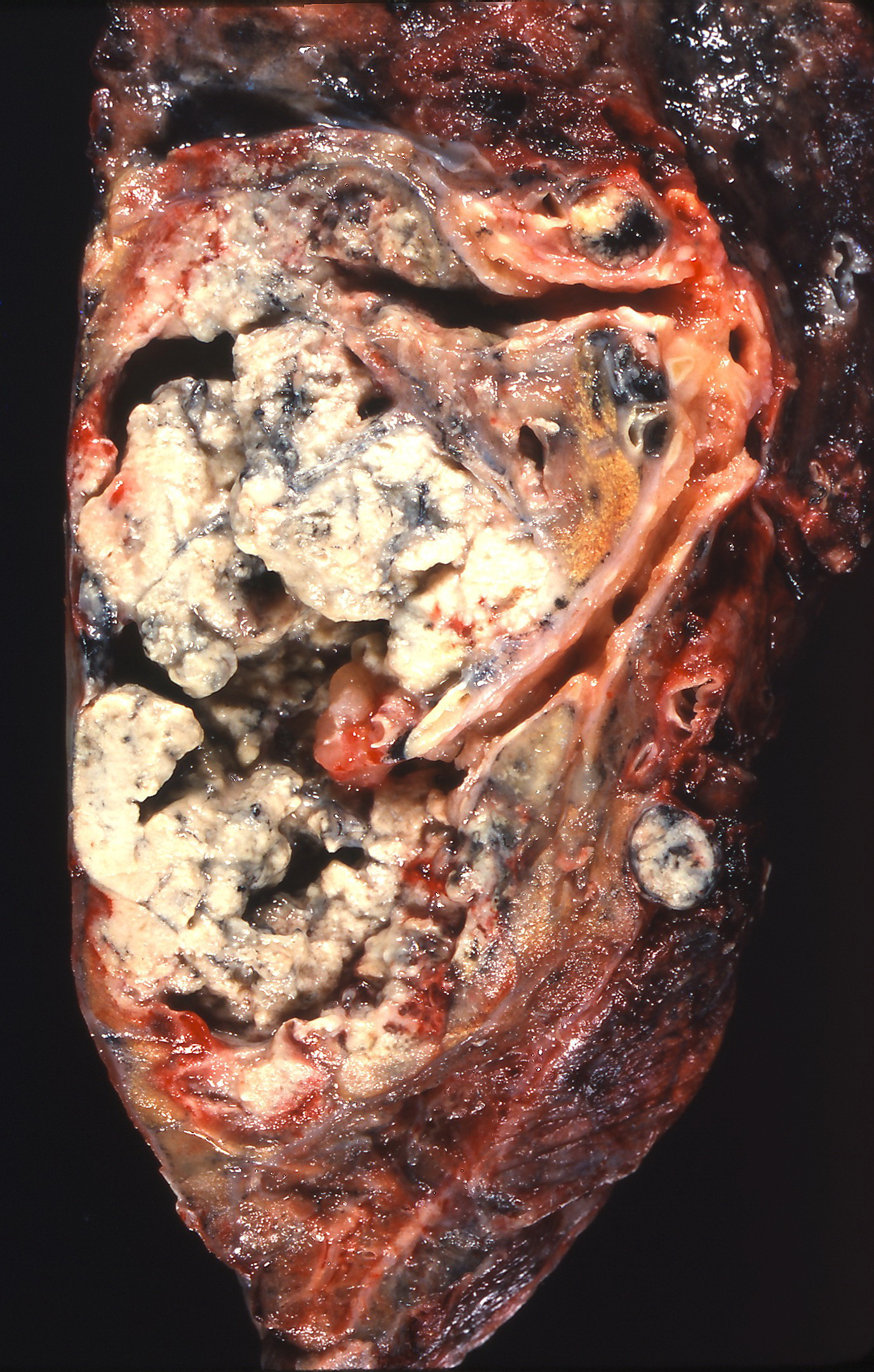
Cavitating Squamous Cell Carcinoma, Creative Commons License from Yale Rosen
The opportunities to attend post mortems are not what they were – when I was at medical school back in Addenbrookes in the mid 90’s, we went to PM every day, apart from Grand Round day, to see the specimens from the morning. We were grilled, but we saw so much, and learnt so much.
I doubt many current medical students ever go to PM. So here’s a great Flikr stream of pathological specimens taken from patients who succumbed to lung cancer. The photos are remarkable, and cover a wide spectrum of disease. Well worth a look.
Posted in Featured, General Respiratory |
Tags: Lung Cancer, Photo Stream, Post mortem |
No Comments »

Pathalogical Empyema Specimen. Creative Common Licensing From Yale Rosen.
Donald MacGregor, consultant paediatrician in Perth, told me about 18 months ago that he had noticed a dramatic increase in empyema cases in children over the preceding year. The reasons for this rise were not clear to him, or me, at the time.
Today, Paediatrics reports the same increase in empyema, and notes that this comes in spite of increased pneumococcal vaccination rates in recent years.
There’s a latin (or Greek) name for everything in medicine. Have you heard the Amateur Transplants song about latin names, Dorsal Horn Concerto?
You must say things like defacate, micturate, copulate. You can’t say things, like……
If you’ve not heard the song, you can go to their online shop, buy the first album, and the proceeds go to Macmillan Cancer.
I digress.
What name do you give to ‘stuff the patient coughs up? If it’s blood it’s haemoptysis, if it’s anything else it’s…. Sputum? Gob? Spit? Loogie? What if it’s something a bit solid.
This week’s BMJ has a short article about a man who coughed up a big blob of tissue, which turned out to be a bit of tumour. They suggest Histoptysis as a Greek name for coughing up bits of tissue. Or Oncoptysis for coughing up bits of tumour specifically.
Will it catch on?
Posted in General Respiratory, Humour |
Tags: BMJ, Expectoration, Histoptysis, Oncoptysis |
2 Comments »


